

What Term Describes The Synthesis Of Rna From A Dna Template?
Want a FREE PDF version of This Article?
Consummate the form beneath and we will email you lot a PDF version of "RNA Polymerase: Role and Definition"
Company Type*
Job Part*
Would y'all like to receive further e-mail advice from Technology Networks?
Technology Networks Ltd. needs the contact data you provide to us to contact yous about our products and services. You may unsubscribe from these communications at any time. For information on how to unsubscribe, as well every bit our privacy practices and commitment to protecting your privacy, check out our Privacy Policy
Ribonucleic Acid (RNA) polymerase is an intermediary enzyme responsible for processing gene sequences into RNA-based genetic fabric that can be utilized in protein synthesis. In this article, nosotros ascertain RNA polymerase and further explore its various functions throughout jail cell biology.
What is RNA polymerase?
RNA polymerase is a multi-unit enzyme that synthesizes RNA molecules from a template of Dna through a procedure called transcription . The transcription of genetic information into RNA is the starting time step in factor expression that precedes translation, the process of decoding RNA into proteins. The RNA molecules produced by RNA polymerase fulfil a variety of roles in the prison cell.
RNA polymerase structure and function (in transcription)
The RNA polymerase enzyme is a large complex made upwards of multiple subunits1. The prokaryotic form of RNA polymerase has 4 subunits capable of transcribing all types of RNA. In eukaryotes, these enzymes have eight or more subunits that facilitate the zipper and processing of DNA throughout transcription.
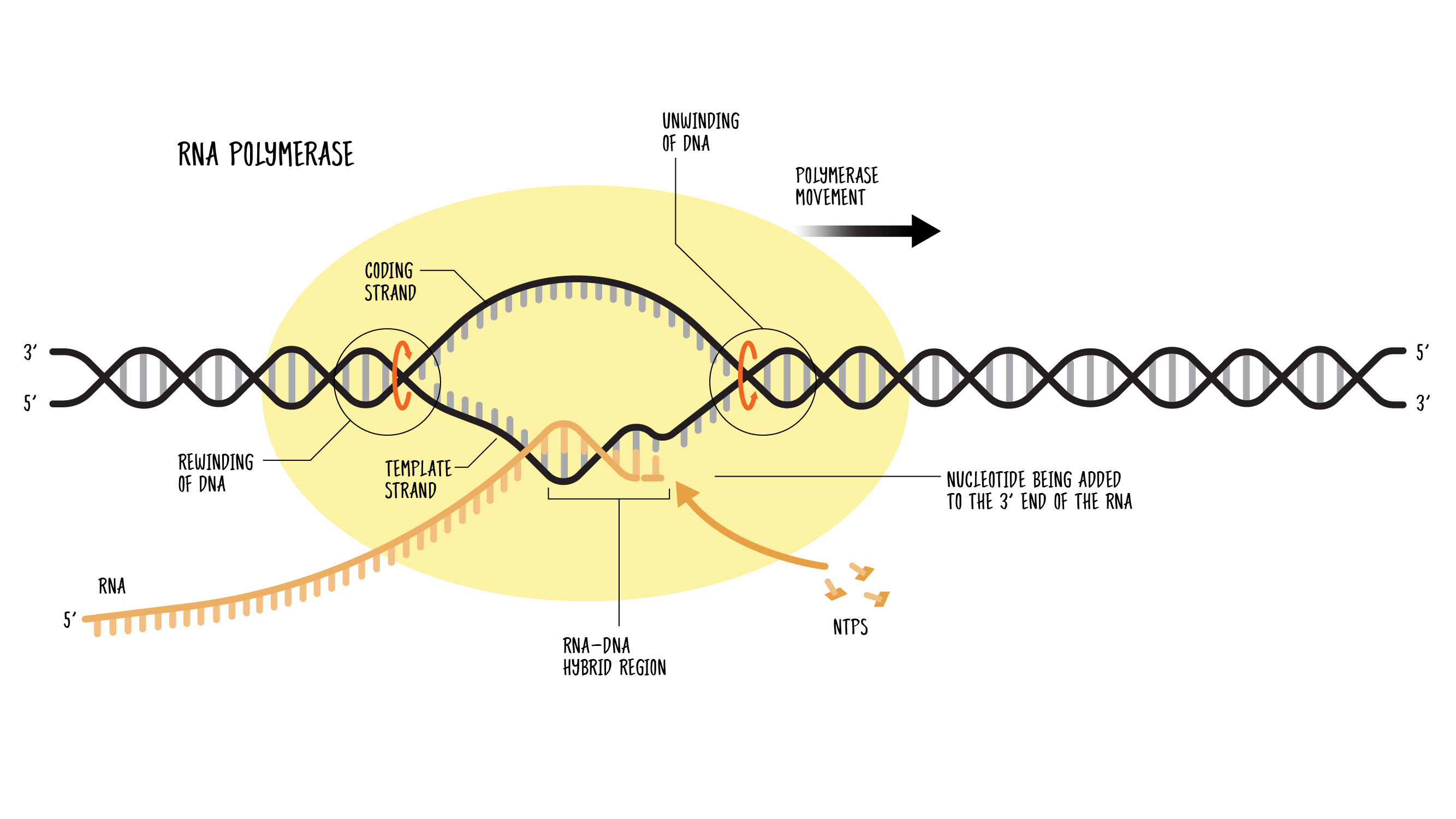
RNA polymerase in activeness
The three stages of transcription involve diverse functions of RNA polymerase that outcome in the synthesis of RNA:
one. Initiation begins when RNA polymerase wraps around the promoter region of Deoxyribonucleic acid. The promoter is a Dna sequence that guides RNA polymerase on where to bind upstream of a cistron. While prokaryotic RNA polymerase can directly bind to DNA promoter sequences, eukaryotic forms require the assistance of transcription factors for initial binding. One time RNA polymerase successfully binds DNA at the targeted promoter region, the enzyme tin can continue with the second phase of transcription.
2. Elongation commences when RNA polymerase unwinds double-stranded Deoxyribonucleic acid into 2 unmarried strands. These Deoxyribonucleic acid strands are used every bit genetic templates for RNA synthesis. As the DNA template strand moves through the RNA polymerase it builds an RNA strand that is complimentary to the transcribed DNA strand.
3. Termination is the final step of transcription. Once RNA polymerase encounters a terminator sequence or bespeak, it stops adding complementary nucleotides to the RNA strand. This is followed by the release of the RNA transcript, which marks the cease of transcription for that template of DNA.
What are the dissimilar types of RNA polymerase?
While prokaryotes like bacteria have one RNA polymerase that transcribes all types of RNA, eukaryotes like plants and mammals tin have numerous forms of RNA polymerase.
RNA polymerase I
RNA polymerase I2 is responsible for synthesizing near ribosomal RNA (rRNA) transcripts. These transcripts are produced inside the nucleolus, a region inside the nucleus where ribosomes are assembled. The availability of rRNA molecules produced past RNA polymerase tin touch on essential functions of cell biology since these transcripts are directly involved with the production of ribosomes.
RNA polymerase 2
RNA polymerase Ii3 transcribes poly peptide-coding genes into messenger RNA (mRNA). This 12-subunit enzyme works equally a complex that directly influences gene expression through its product of pre-mRNA transcripts. In one case the pre-mRNAs are released by RNA polymerase 2 inside the nucleus, biochemical modifications set these transcripts for translation. RNA polymerase Ii also produces micro RNA (miRNA) molecules. These non-coding transcripts tin can mediate gene expression and the activity of mRNAs later on transcription.
RNA polymerase 3
RNA polymerase IIItwo transcribes rRNA genes into minor RNAs like transfer RNA (tRNA) and 5S rRNA. These smaller RNA transcripts play a role in normal cell role throughout the nucleus and cytoplasm.
RNA polymerase 4 and Five
Exclusively found in plants, RNA polymerase 4 and V are transcription enzymes that evolved as specialized forms of RNA polymerase II4. Both enzymes produce small interfering RNA (siRNA) transcripts, which play a role in the silencing of plant genes.
RNA polymerase vs Deoxyribonucleic acid polymerase
Deoxyribonucleic acid polymerase synthesizes double-stranded Dna molecules from unwound DNA strands during replication. Even though the stop products of replication and transcription are different, they both work upon Deoxyribonucleic acid by adding nucleotides in the same v' to 3' direction. In contrast with RNA polymerase, DNA Polymerase is semi-conserved process that utilizes both strands of a double-stranded DNA molecule as a template for replication.
| Comparing | RNA Polymerase | DNA Polymerase |
| Role | Transcription of DNA | Replication of DNA |
| Purpose | To make RNA copies of genes | To copy the entire genome |
| Time of occurrence | Used in transcription during Grand phase(s) | Used in replication during Due south phase |
| Primer | Non required for transcription | Required for initiation of replication |
| Base pairs used to synthesize product | Adenine, Guanine, Cytosine and Uracil | Adenine, Guanine, Cytosine and Thymine |
| Resulting product | Single-stranded RNAs (e.thousand. mRNA) | Double-stranded DNAs |
RNA polymerase and drugs
RNA polymerase is an bonny target for drug development due to its ubiquitous presence and office throughout life. The biochemical differences in RNA polymerase between prokaryotes and eukaryotes allow for specific drugs that target microbial RNA polymerases without whatever interaction with our own.
Several antimicrobial drugs part as RNA polymerase inhibitors by blocking bacterial or viral enzyme activity during one stage of transcription. For example, the rifamycins5 are a grouping of bacterial antibiotics that inhibit elongation by blocking the leave aqueduct of RNA polymerase. These drugs are commonly used to treat challenging infections caused by leprosy and tuberculosis.
References:
1. Mooney RA, Landick R. RNA polymerase unveiled. Cell. 1999;98(6):687-690. doi:10.1016/s0092-8674(00)81483-x.
ii. Khatter H, Vorländer MK, Müller CW. RNA polymerase I and Iii: like yet unique. Curr Opin Struct Biol. 2017;47:88-94. doi:10.1016/j.sbi.2017.05.008 .
iii. Schier Ac, Taatjes DJ. Structure and mechanism of the RNA polymerase II transcription machinery. Genes Dev. 2020;34(seven-8):465-488. doi:10.1101/gad.335679.119 .
iv. McKinlay A, Podicheti R, Wendte JM, Cocklin R, Rusch DB. RNA polymerases Iv and V influence the 3' boundaries of Polymerase II transcription units in Arabidopsis. RNA Biol. 2018;15(2):269-279. doi:10.1080/15476286.2017.1409930 .
5. Sensi P (1983). "History of the development of rifampin". Reviews of Infectious Diseases. five Suppl 3: S402–6. doi : ten.1093/clinids/5.supplement_3.s402 . PMID 6635432

What Term Describes The Synthesis Of Rna From A Dna Template?,
Source: https://www.technologynetworks.com/genomics/articles/rna-polymerase-function-and-definition-346823
Posted by: gorbyuped1966.blogspot.com
0 Response to "What Term Describes The Synthesis Of Rna From A Dna Template?"
Post a Comment